Straight answers to
the questions that matter.
Making big decisions about your home or someone you care for isn't easy. These guides explain the options clearly — no jargon, no upsell.

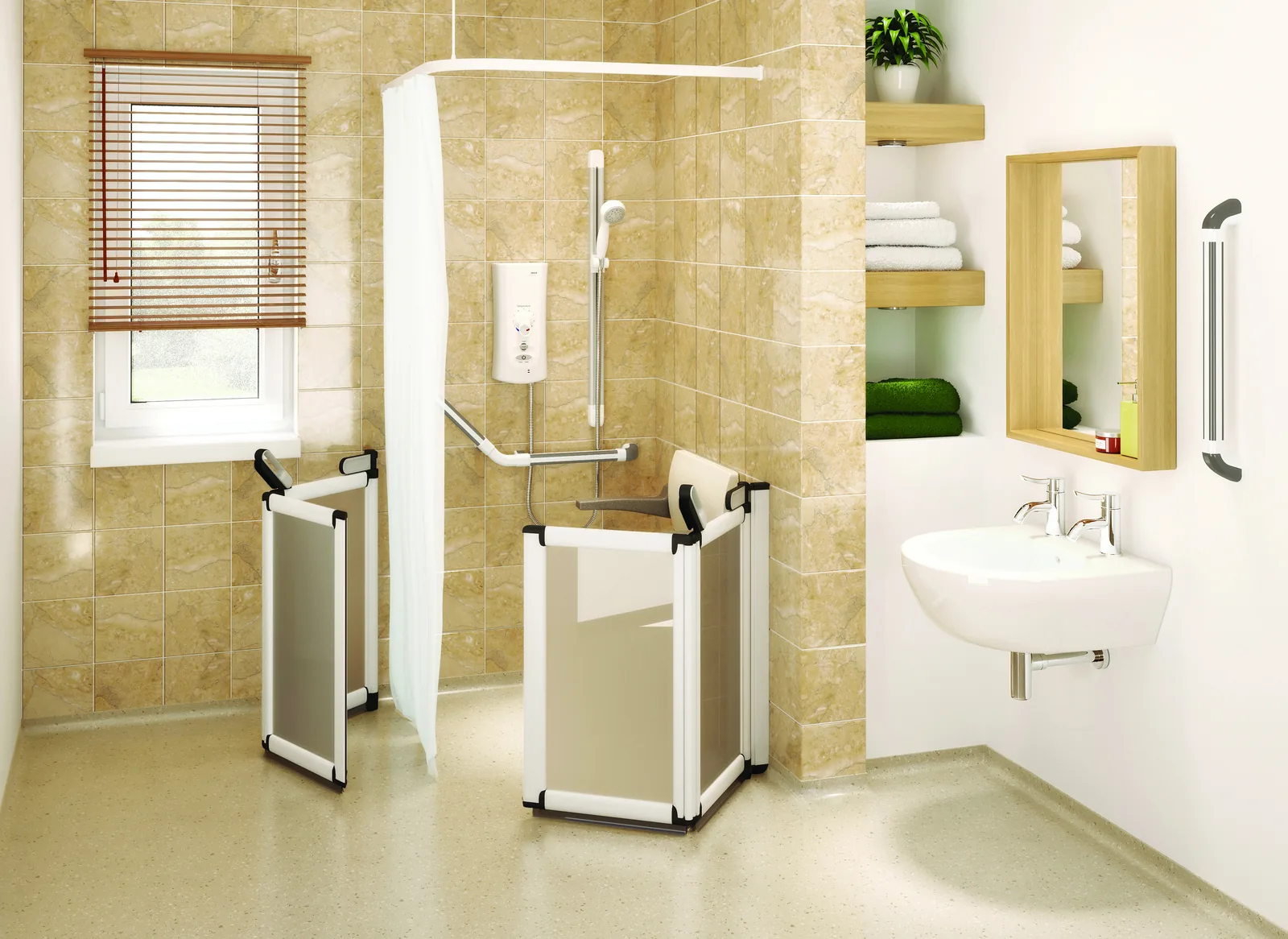
Half-height shower doors, made to measure
Waist-high doors that keep the water in and let a carer reach over the top.
A full shower enclosure is a problem the moment somebody has to help: the carer either gets soaked leaning through the door, or the door stays open and the water goes on the floor. Half-height doors solve both — tall enough to hold the spray, low enough to reach over.
They are made to the size of your opening rather than bought off a shelf. Our full guide covers how to measure, both configuration systems we order from, and what changes between a wet room floor and a step-in tray.
In this guide
- Strong opaque PET panels, not glass
- PROCare made-to-measure in the UK, with a lifetime guarantee
- Every PROCare MOD configuration and product code listed
- Left or right-hand entry, white or silver
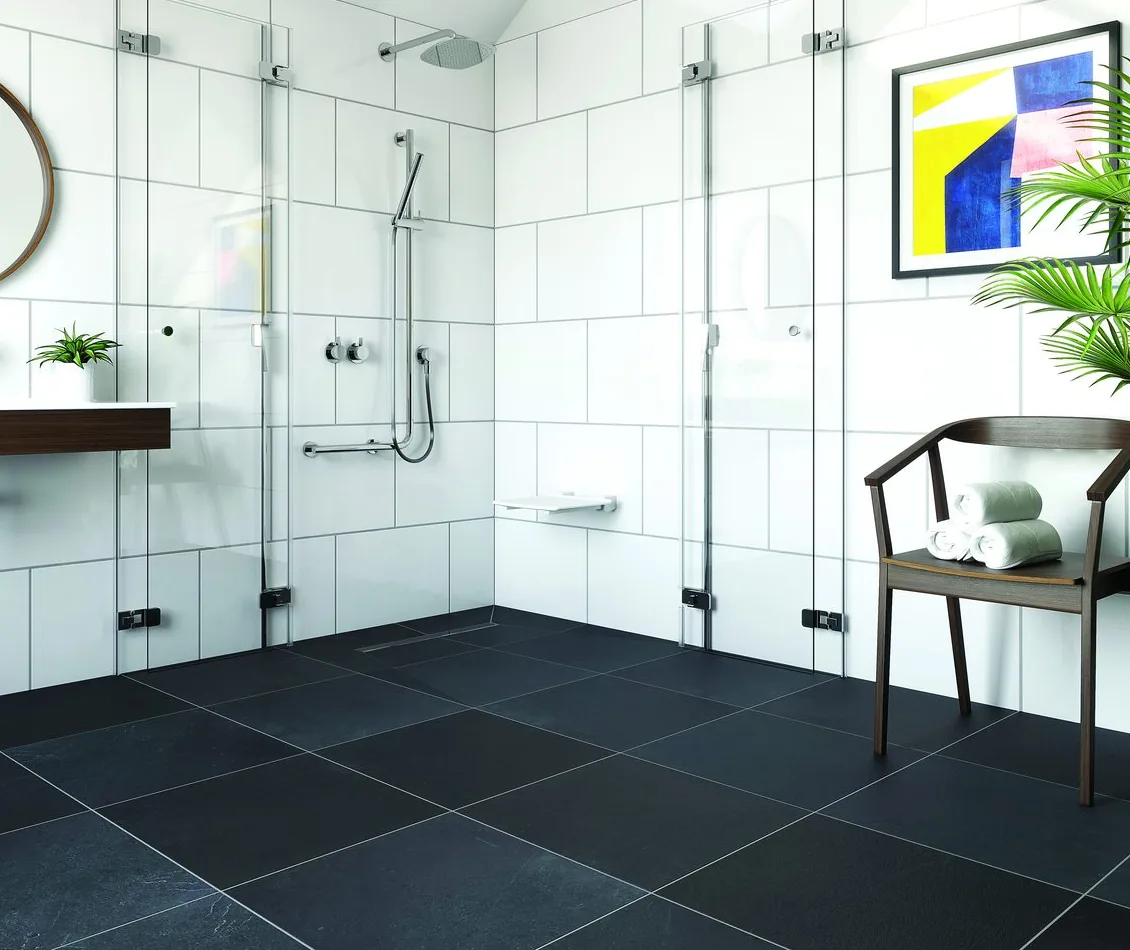
Level-access floors: how a wet room deck goes in
What a floor former is, and what fitting one actually involves.
The floor former is the part that makes a wet room a wet room. It is a moulded panel with the fall to the drain already built in, so nobody has to hand-screed a slope that has to be right in every direction.
It drops into a cut-out in the existing floor, is fixed down, then tanked and tiled over. Our full guide walks through the sequence step by step, covers timber versus concrete floors, and links the manufacturer's own fitting document.
In this guide
- 22mm board — the same depth as floorboards
- Drain rotates 360° to clear joists and pipework
- Suits timber and concrete sub-floors
- Manufacturer's installation guide included
What is a wet room?
And how does it differ from a standard shower or accessible bathroom?
A wet room is a fully waterproofed bathroom where the shower area has no step or lip: the floor is tanked and drains directly. This makes it the most accessible option for people with limited mobility, wheelchair users, or anyone who needs to reduce fall risk.
Unlike a standard shower tray, there's nothing to step over. The entire floor is level, making transfers from wheelchairs or walking frames much easier.
Who benefits most:
- Wheelchair users needing roll-in access
- Anyone with balance or mobility issues
- Carers who assist with bathing
- Older adults planning ahead
Choosing the right grab rail
There are dozens of types. Here's how to pick the right one.
Grab rails are one of the most cost-effective home adaptations available, but only when they're the right type, in the right position. The wrong placement can give a false sense of security.
Key types:
- Straight rails: for pushing up from seated positions
- Angled rails: for sit-to-stand transitions
- Folding rails: useful where space is tight
- Toilet frames: freestanding support around the toilet
Positioning matters as much as the type. When in doubt, come into the showroom: it's much easier to understand placement when you can see and touch the options.
Wheelchairs vs. rollators — what's the difference?
Understanding the options before you commit.
The right mobility aid depends on how much independent mobility someone has and how much support they need.
Rollators (wheeled walkers) are for people who can walk but need stability support. They provide a frame to lean on and usually include a seat and basket. Good for indoor and outdoor use.
Wheelchairs are for people who cannot walk or tire very quickly. Self-propelled chairs allow the user to move independently; attendant-propelled chairs are pushed by a carer.
- Trial in the showroom before you buy
- Consider indoor vs. outdoor use
- Check doorway widths at home before choosing a model
Bath lifts and bath boards — what's right for you?
Staying safe in the bath without a full wet room conversion.
Not everyone needs or wants a full wet room. For people who want to continue using a bath, there are products that make it significantly safer.
Bath boards span the top of the bath and allow someone to sit on the edge and swing their legs in, eliminating the need to step over the bath side.
Bath lifts lower the user into the water and raise them back out at the press of a button. Powered by a rechargeable handset. No structural work required. Fits any standard bath.
- Bath boards: simple, low cost, immediate
- Bath lifts: better for people who struggle to lower/raise themselves
- Both available to try in our showroom
VAT relief: many of our customers pay no VAT at all
Most of what we sell is eligible for VAT relief. This is not a refund or a discount scheme — where it applies, the VAT simply is not charged in the first place, so the price you pay is the price you see less the VAT. There are two separate rates, and which one applies depends on you, not on the product.
If you are chronically sick or disabled
Any age. HMRC’s test is a physical or mental impairment with a long-term and substantial adverse effect on your ability to carry out everyday activities, or a condition the medical profession treats as a chronic sickness.
- Grab rails, ramps, bath lifts and stair lifts
- Wheelchairs, walking aids, commodes and sanitary devices
- Adapting a bathroom in your own home — including replacing a bath with a level-access shower
- Widening an existing doorway, and the preparation work that goes with an adaptation
If you are 60 or over
A separate, lower rate for older customers who are not chronically sick or disabled. It covers installation in your own home, and only when we supply and fit the item ourselves.
- Grab rails and ramps
- Stair lifts and bath lifts
- Built-in shower seats, and showers containing one
- Walk-in baths with a sealable door
What you need to do: sign a short written declaration confirming you qualify. You do not need a doctor’s note and HMRC does not have to approve it — but we do have to hold one for our records, so tell us before you order and we will go through it with you.
What does not qualify: a temporary condition such as a broken limb; being older on its own, for the 0% rate; and general-purpose products that are useful to a disabled person but were not designed solely for one.
This is a plain-English summary, not tax advice, and it is your circumstances that decide it. The full rules are in HMRC’s VAT Notice 701/7 and its plain-English summary on GOV.UK. The Low Incomes Tax Reform Group also explains the reliefs well. If you are unsure whether something qualifies, ring us on 01642 250 511 and ask — we would rather tell you than have you guess.
Disabled Facilities Grant (DFG): what you need to know
If you or someone you care for has a disability, you may be entitled to a Disabled Facilities Grant: a government-funded grant to help pay for home adaptations. It's means-tested and covers up to £30,000 in England.
Contact your council. Call the housing or adult social care department.
OT assessment. An occupational therapist recommends what adaptations are needed.
Means test. The council assesses your contribution based on income.
Grant approved. Works commissioned. CDS can supply products directly.
CDS works directly with local councils as a council-approved supplier. If your adaptation has been approved, we're already on the list. Call us and we'll guide you through the supply side.
Still not sure? Just ask us.
Thirty years of experience means we've probably seen your situation before. There's no obligation to buy: just a straight conversation about what will actually help.